
A schedule does not fail because someone forgot a date. It fails because two parties made different assumptions about who owned a decision, and nobody caught it until concrete was poured. In a major civil job, effective construction project management exists to control that exact risk – not just stare at a Gantt chart.
Public infrastructure contracts bring together multiple organisations. Delivery models like alliances mean structural engineering, environmental compliance, and civil works all share one budget and one public deadline. Construction project management on these jobs is not about running a single crew. It is about keeping multiple companies aligned without anyone dropping the ball at the handover point.
Why alliance contracts change how construction project management works
Most private builds run on a single head contractor model. One company holds all the risk, manages the schedule, and answers for the outcome. Government infrastructure delivery frequently uses an alliance structure. In an alliance, the client and delivery partners share risk, reward, and responsibility.
That setup only works when teams keep it simple and collaborate rather than fight over contractual fine print. When something slips, there is no single party to blame. Coordination must be seamless. Decisions happen jointly, and programs focus on shared dependencies. Because public funds are involved, complete transparency is baked straight into daily operations.
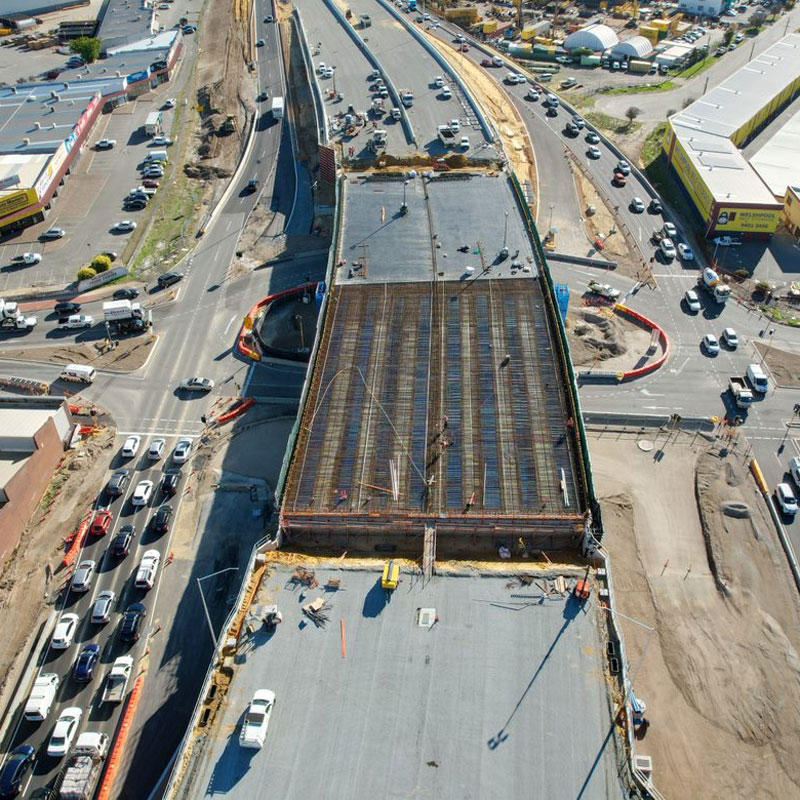
Westforce Construction worked inside this exact structure as a Sub-Alliance Partner on the Leach Welshpool Alliance. This Main Roads WA project upgraded the Leach Highway interchange at Welshpool Road alongside Georgiou Group, BG&E, and Golder & Associates. It serves as a clear case study for practical construction project management. It brought together multiple parties on an active road where clear communication was non-negotiable.
What changes when the construction site stays live
Managing public infrastructure is far tougher than an empty greenfield build because the site remains active. On the Leach Welshpool project, crews built bridge piers directly next to live traffic lanes. Schedules had to balance complex traffic management and public safety against concrete pours, drainage, and precast installs.
This requires strict planning discipline. Every activity must account for moving traffic around it, not just structural work above or below. Delays cause immediate public disruption. Project teams must manage risk in both directions – protecting the project timeline and safeguarding road users every day.
How procurement teams should evaluate construction project management capability
When assessing a contractor for a public tender, look beyond simple schedule promises. Evaluate these core areas:
- Pre-qualification matching the scope: Categories such as R5 (road), B4 (bridge), and F150+ (financial capacity) confirm a contractor can handle actual project risk – not just make claims on paper.
- Experience in shared-risk frameworks: Contractors used to sole-contractor setups often struggle in alliances where decisions, risks, and ownership are fully shared.
- Proven history on constrained sites: Managing works around live traffic and active plant requires specialised expertise, not generic oversight.
Construction project management on public infrastructure is not about flashy promises. It relies on steady coordination, practical problem-solving, and clear communication. At Westforce, our promise is simple: we do what we say, no excuses. Delivering on that commitment means handling the hard coordination behind the scenes, long before a delay makes headline news. Contact us to discuss how Westforce can be a part of your next project.